
Thanks to a Black Friday sale, I pulled the trigger on The Best Beginner Woodworking Course…Period! Honestly, I was a little put off by the “beginner” word. After all, I’ve been woodworking for decades.
But as I’ve often coached people in my main hustle, it’s not how long you’ve been doing something that is important – it’s how much you’ve learned while doing it. Too many people settle into the routine of a job and then later feel entitled to another job because they have twice the experience of other applicants. What did you do during your tenure that demonstrated growth and aptitude for this new job?
And so I’m proud to say that I don’t have too much pride to sharpen my skills with a “beginner” woodworking course. Upon self reflection:
- Outside of a middle school wood shop class, I don’t have any formal training. I’m self-taught and have gotten to where I am through a truck load of trial and error.
- Watching better woodworkers on YouTube has helped a ton, but it has also encouraged me to try things that were well above my pay grade and it naturally led to more mistakes. The positive spin is that it accelerated my learning curve, but still, I can’t deny a “back to basics” refresher would be good for me.
- A woodworking course that doesn’t teach me anything new still has value in the sense that I don’t know what my skill level is.
And if I needed another reason (I didn’t), I’ve really enjoyed the free videos that Chris, Shaun, and Jon have already put on YouTube. They’ve earned my respect as top-notch woodworkers, and I have no problem paying them for the time they put into this course. Shout outs to their individual channels, all of which are tracked in the YouTube Woodworkers Dashboard:
Course Structure
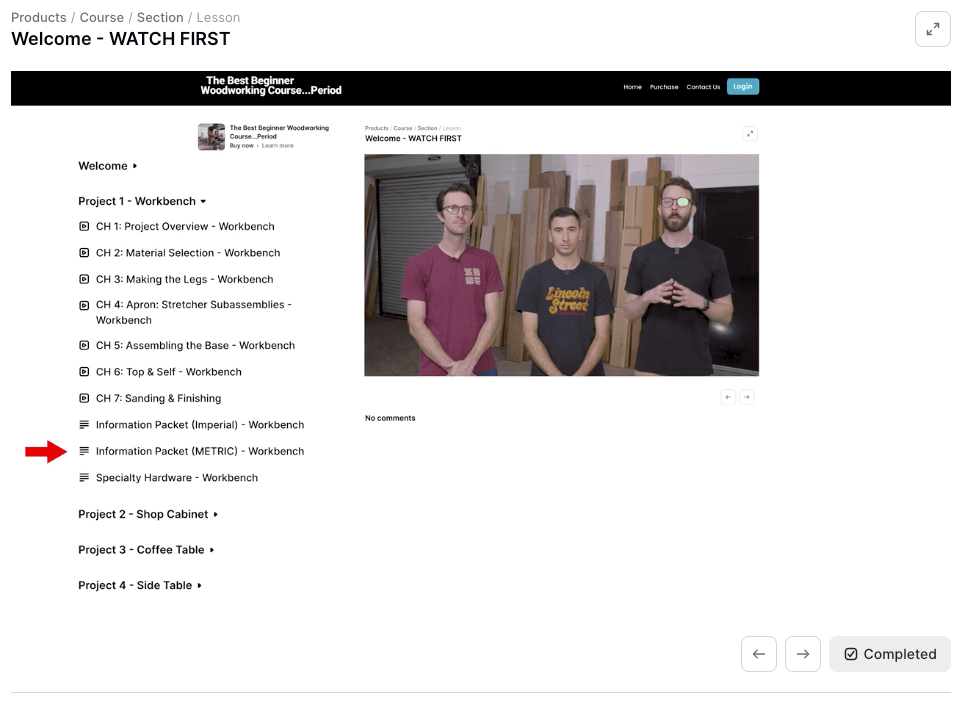
The (best beginner) woodworking course (…period) is organized into 10 sections and a total of 64 videos.
- Welcome. 4 videos.
- Project 1 – Workbench. 7 videos and 3 information packets.
- Project 2 – Shop Cabinet. 10 videos and 3 information packets.
- Project 3 – Coffee Table. 8 videos and 3 information packets.
- Project 4 – Side Table. 9 videos and 3 information packets
- Tool Overviews. 11 videos.
- Skill Builders. 9 videos.
- Links. 2 PDFs. One is an aggregated list (with links) of the specialty tools and hardware used in all of the projects. The other explains how to join the Discord for the course.
- Round Table Discussions. 3 videos.
- Live Q&A sessions. 3 videos of Q&A sessions from February, March, and June 2025.
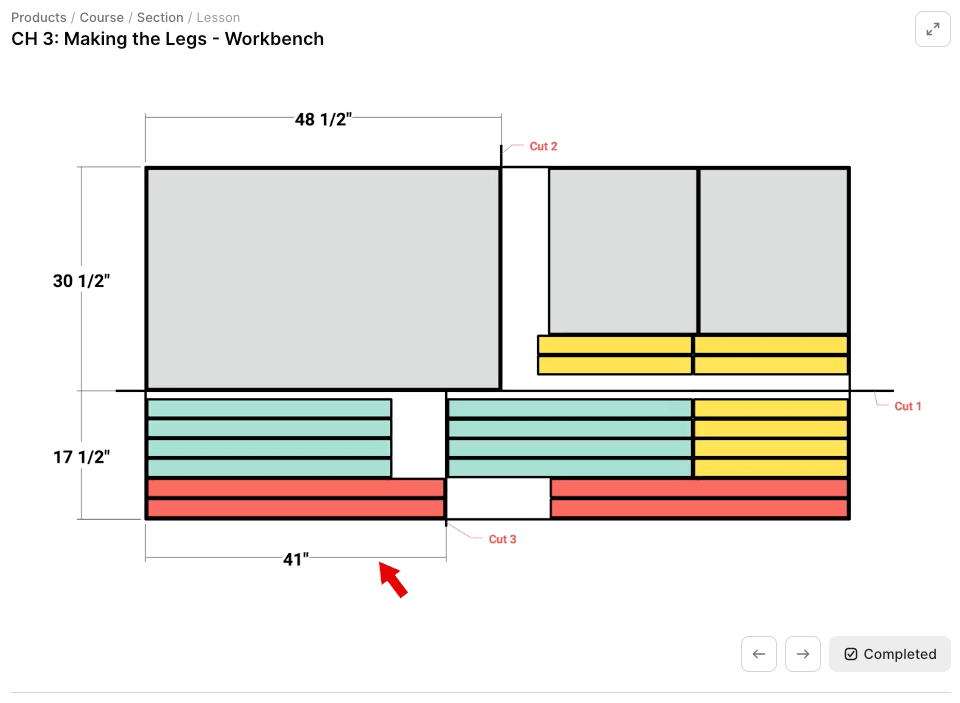
What I learned
I’m going to resist the urge to thoroughly review every element of this woodworking course. Trust me when I say the projects were thoughtfully selected and logically build upon each other. The tools and techniques are all explained very clearly. Keeping in mind that I THINK I’m better than a beginner but decided to take the course anyway, I want to share what I learned even as an experienced woodworker.
- When working with plywood, it’s easy to forget that the surfaces have a grain. If you’re cutting across the grain, you’ll need to put down masking tape to prevent tear out. I honestly never thought about this until it was mentioned in this course. I just dealt with the sanding necessary to fix the tear out. The time savings is minimal if you’re using an appropriate blade (60+ teeth on a 10-inch table saw blade, for example), but I can recall cases of bad tear out (I use a lot of cheap plywood) where sanding didn’t always do the trick.
- The doors for the shop cabinet project were cut from a single piece of plywood. That would normally ensure a perfect center line or seam where the doors meet in the middle, but you can see in the video the seam is just slightly misaligned. After installing the doors, the gap is narrower at the top than it is at the bottom. More expensive hinges allow you to make fine adjustments to correct for this, but the project used very basic hinges. I probably would have tried re-installing the hinges in a different place to get the alignment right, but there’s no guarantee it would have worked. Shaun’s solution was to take his circular saw and cut right down the center line. It’s a little bit sloppy (the perfectionist in me doesn’t like that the doors are now just slightly out of square), but it was smart and efficient. He didn’t even take the doors off the cabinet! It’s shocking to see this kind of crude fix in a woodworking course, but I thought it was great.
- All of the angles in the coffee table project are 10 degrees. Chris made a jig for this and explained, “it doesn’t matter if they’re all exactly 10 degrees, it matters that they’re all the same.” Perfectly said, and I know this, but I still mess it up sometimes. It’s because I’m too confident in my miter saw measurements. Say I cut all of my leg pieces on my miter saw at 10 degrees. They’re exactly the same because I did them all at the same time. Later, I notice one of the leg pieces has a blemish in it and decide to cut a new leg piece. I reset my miter saw to 10 degrees and make the cut. Once fully assembled, the table wobbles ever so slightly. Bummer. It’s because that last leg was 10.1 degrees while the other three are at 9.9 degrees. It’s easy enough to fix, but Chris reminded me of how important it is to make all of these cuts at the same time.
- Not all squares are square. Really?! In the Tools section, Jon showed how to test a square for accuracy. It’s super simple and does not require the purchase of another square for calibration. I immediately went to my workshop and tested all of my squares. Sure enough, there was one that didn’t pass and is now in the garbage can!
- Avoid staining soft woods like pine – they rarely turn out the way you want, even if you take the time to apply a conditioner before staining. I can be a cheap bastard, so I’ve tried more than once to make pine look like walnut. It never worked, but I always thought it was because I was too cheap to buy wood conditioner. Now I know. If I want something to look like walnut, buck up for real walnut!
- I learned the most about finishes. Water-based finishes are generally better suited for light-colored woods, while oil-based finishes are more suitable for dark-colored woods. When using water-based finishes, the wood should be water-popped before the first coat. Oil-based polyurethane can be mixed 50-50 with mineral spirits, then wiped on (it’s hard to use a brush without leaving brush marks and air bubbles). When using lacquer, you don’t need to sand between coats, and you can use a brown paper bag to buff out the final coat.
Conclusion
Honestly, my main takeaway from the course is that I’m not a beginner woodworker. The overwhelming majority of the course covered techniques I was already familiar with and information I had already absorbed from somewhere else. In the live Q&A sessions, I could have answered most of the questions posed by viewers.
So does that mean the course was a poor investment for me? Not at all. One of my fears as a self-made woodworker who just figures things out as he goes is that I’m not doing things correctly or the way a formally trained woodworker would do them. I think I can put that fear behind me now. There’s confirmatory value in seeing how expert woodworkers like Jon, Chris, and Shaun are doing things.
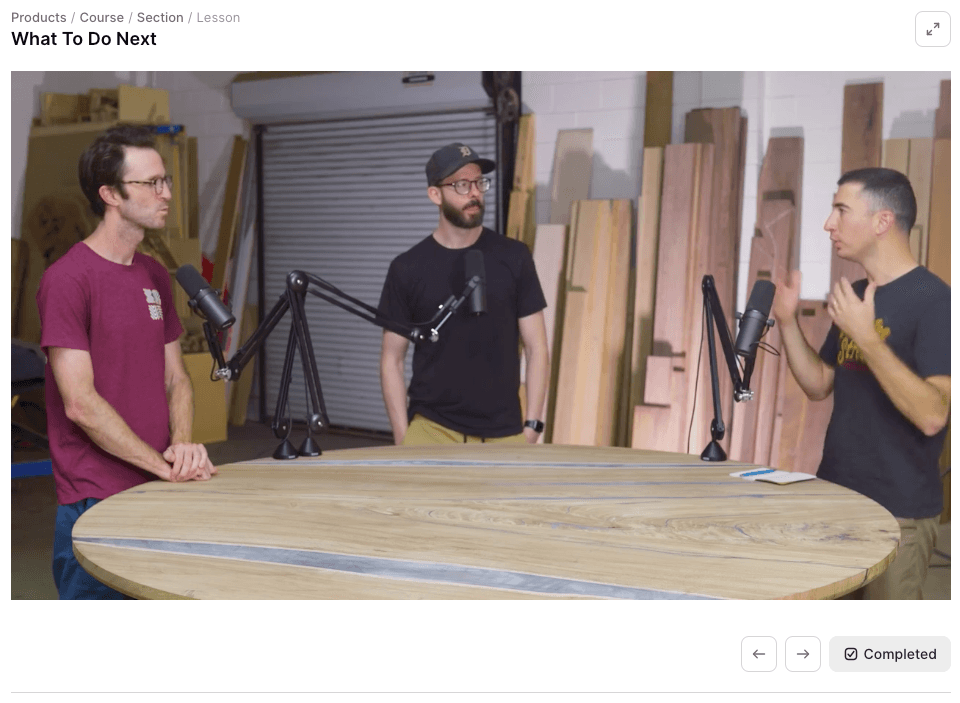
And to be fair, if I could jump in my time machine and take this woodworking course back when I truly was just beginning, well, it would have been a stellar investment because it would have taught me a lot of things that I learned through trial and error. I was jealous of some of the students who were clearly taking this course at the right time in their woodworking journeys.
The Best Beginner Woodworking Course…Period gets my full endorsement. It is appropriately stocked with the kind of guidance and advice a beginning woodworker wants and needs. Even as an experienced woodworker, there is tremendous value in getting a refresher on the basics.